
The Sunset of Traditional Strategic Planning and the Dawn of Dynamic Strategic Governance™
By Dave Crocker
For decades, strategic planning has been one of the most important responsibilities of credit union leadership. Boards, CEOs, and management teams have invested significant time and resources into developing annual strategic plans intended to guide organizational direction and growth.
Yet many institutions continue to face a common challenge: creating a strategic plan is not the same as achieving strategic success.
Today’s operating environment is changing faster than ever before. Member expectations continue to evolve. Digital transformation is accelerating. Competition from banks and fintech organizations is intensifying. Regulatory requirements are becoming increasingly complex. In this environment, a strategic plan created during an annual planning cycle can quickly become disconnected from day-to-day execution and emerging realities.
As a result, many leaders are beginning to recognize that the future of strategic leadership requires more than traditional strategic planning.
It requires Dynamic Strategic Governance™ (DSG).
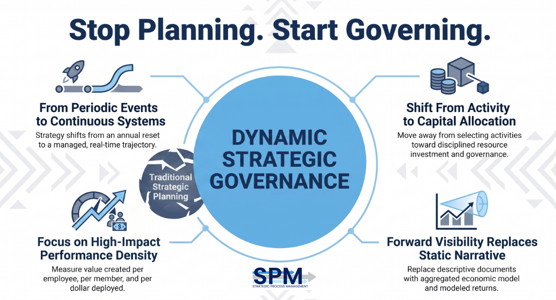
Moving Beyond the Annual Planning Event
Traditional strategic planning is often treated as an event. Organizations gather periodically to establish goals, develop initiatives, and publish a strategic plan that serves as a guide for the coming year.
Dynamic Strategic Governance approaches strategy differently.
Rather than treating strategy as a document, DSG treats strategy as a continuously governed system. Organizational goals, departmental priorities, strategic initiatives, performance metrics, and governance activities remain connected throughout the year, allowing leadership teams to continuously evaluate progress, adjust priorities, and maintain alignment.
The focus shifts from simply creating a plan to actively governing strategic success.
Measuring Value Instead of Activity
A key principle of DSG is the shift from activity-based measurement to value-based measurement.
Many organizations continue to measure success through activities completed, projects launched, meetings held, or training delivered. While these metrics provide operational visibility, they often fail to demonstrate organizational value.
Dynamic Strategic Governance encourages leaders to focus on outcomes that matter to THEIR credit union like:
- Revenue Growth
- Asset Growth
- CapEx and OpEx
- Productivity improvements
- Expense reductions
- Member retention and addition
- Risk mitigation
- Strategic capacity growth
- Return on investment
This allows leadership teams to better understand the value being created by strategic initiatives rather than simply measuring activity levels.
Creating Enterprise Alignment
One of the greatest challenges in strategic execution is ensuring alignment between organizational goals and departmental activities.
DSG establishes a clear strategic hierarchy in which organizational goals define the desired destination while departments develop roadmaps that directly support those goals. This creates visibility, accountability, and coordination throughout the institution.
When every department understands its role in achieving organizational success, strategy becomes more cohesive, execution becomes more coordinated, and leadership gains greater confidence in the institution’s direction.
The Future of Strategic Leadership
The most successful credit unions of the future will not necessarily be those with the largest budgets or greatest resources.
They will be the institutions that create the greatest strategic clarity.
They will continuously evaluate relevance, align organizational efforts, measure meaningful outcomes, and govern strategic execution with discipline and transparency.
In short, they will move beyond traditional strategic planning and embrace Dynamic Strategic Governance.
Enabling DSG Through Purpose-Built Infrastructure
Dynamic Strategic Governance is more than a methodology—it is a complete strategic operating model.
To support that model, Strategic Process Management (SPM) developed ProStrategy.ai, the only purpose-built platform specifically designed to execute DSG.
Unlike many products marketed as strategic planning software, which primarily function as project management and reporting tools after a strategy has already been developed, ProStrategy.ai supports the entire strategic lifecycle. Leveraging artificial intelligence, it helps leadership teams develop strategy, assess organizational readiness, align departments, establish measurable value metrics, support Steering Committee governance, coordinate with PMO functions, and continuously monitor strategic progress.
The result is a fully integrated environment where strategy creation, governance, alignment, execution, and measurement operate together within a single framework.
While traditional tools help organizations manage strategy, Dynamic Strategic Governance and ProStrategy.ai help organizations create, govern, align, and execute strategy—transforming strategic planning from an annual event into a continuously managed system for organizational success.
For more information, contact us at info@spm.consulting or visit our website.
Latest Insights
The Sunset of Traditional Strategic Planning and the Dawn of Dynamic Strategic Governance™
Known for their member-focused ethos, credit unions have the opportunity to carve out a significant niche…
Reputation Management in the AI Era: Why Credit Unions Can’t Afford to Be Invisible
Known for their member-focused ethos, credit unions have the opportunity to carve out a significant niche…
Crafting a Growth-Oriented Marketing Strategy for Credit Unions
Known for their member-focused ethos, credit unions have the opportunity to carve out a significant niche…